Showing posts with label love. Show all posts

Tuesday, October 10, 2017

Get Out of Your Head (and Into Your Heart)

There is power in getting in touch with our hearts through meditation; but we can never think our way into this connection. We have to humble and quiet the arrogant brain and speak the heart’s language.

A lot of people come to meditation with the notion that it’s a brain activity, something that we do with our thinking, logical minds. We sit down to be still, and instead we encounter the thinking mind’s untamed wildness. We spend a lot of our time in meditation dealing with that part of our being that exists from the neck up. And that alone seems like it could be a full-time job!

https://www.yogajournal.com/meditation/meditation-get-out-of-disembodied-head-mode-surrender-to-heart


But humans are not just disembodied heads, despite how much it might feel that way sometimes. Below the neck is a whole other realm of embodied experience unfolding in every moment, a vast world of sensations and pulses and somatic messages coursing through our veins and our nervous systems. Our gut often knows things instinctively, and instantly, in ways the brain can’t quite comprehend. The enteric nervous system, which rules the gut, has 100 million neurons, more than can be found in the 45 miles of nerve fibers running through the spinal cord and the peripheral nervous system. The body has its own forms of knowledge and even wisdom, whose workings often remain hidden from the conscious mind. The body’s mysterious wisdom is experienced as sensation, feeling, intuition, and emotion.

This is an excerpt from an article I published last month in Yoga Journal. Read the full article here.

Thursday, February 18, 2016

¡Viva Cuba!

When Adrian and I agreed to lead a group of almost 30 Americans on a yoga and meditation retreat to Cuba, I don’t think we quite understood what that would mean, or how profoundly we would be transformed by the experience. After months of anticipation, the trip to Cuba finally took place last week. Our heads and hearts are still spinning with the things we saw and felt.

Everything in Cuba moves more slowly, takes more effort, and involves more risk. As a functioning society, it is not a well oiled machine. Certain things about life there seemed to freeze in 1959 and have remained unchanged since then. So many things are broken, or patched together. People find ingenious ways to make things work, even if it’s with the most humble solutions and materials at hand — but they are always proud of whatever they have. The moment is always now. Whatever they lack in terms of comfort, amenities, infrastructure is compensated in their smiles, cheerfulness, humanity, and a sincere desire to live the best life they can. It is mind-blowing.

Chickens designated for sacrifice in an Abakuá religious ritual.
Callejón de Hamel, Havana.

Less than six months ago, the U.S. reopened its embassy in Cuba, and the U.S. flag was raised again alongside other countries’ flags for the first time in over half a century. In the news yesterday, the U.S. and Cuba announced that they will resume a full schedule of commercial flights, and in the news today President Obama announced that he will visit Cuba next month. This will be the first visit to Cuba from a U.S. president in 88 years. The last U.S. president to visit was Calvin Coolidge. The winds of change are blowing.

We asked some locals what they and their friends thought of the lifting of the embargo and the new influx of American tourists and investments. For the most part they welcome it, because it brings much-needed economic relief. But they also fear how the sudden rush of American influence may change the island and its culture.

Havana seen from a high floor of the Habana Libre hotel.


We saw stunningly beautiful things in Cuba—not only in the places we went, but more importantly in the people we met. And we saw heartbreaking things too: crumbling buildings, shocking poverty, and a society of men and women forced to piece together a life out of almost nothing. We saw people’s cheerfulness and dignity, their pride in whatever little they have. But beneath the smiles, beneath the dignity, were things we could not see because our eyes are not Cuban eyes. As one Cuban-American friend said to me:

“There's plenty of beauty on that island. There always was. And of its resources, it is its people by far that make it the special place it is. But they are my people. I know them too well. I know of the pain behind their laughter. I know of the shame behind their dignity. I know what it's like to feel lesser than any visitor from the outside — “de afuera.” Because most Cubans are serving a life sentence on an island they can't wait to get out of, isolated from the rest of the world, their only contact with the outside from hearsay, pictures and movies.”

Woman on street in Old Havana.


After the initial thrill of stepping into a time capsule wears off and you have taken a hundred or more pretty photos of old 1950s American cars driving on picturesque streets filled with decaying colonial-era buildings, you start to get a sense of what lies beneath the exterior: the daily struggle to survive in a third-world country that has been politically and economically isolated from its giant neighbor to the north. Those American cars have been kept running for half a century with makeshift Soviet parts, because after 1959 no more American parts could be obtained to fix them. They spew black fumes that choke the air of Havana’s streets.

Taking old American cars for a night out on the town.


The pride of most Cubans for what they have—even if it seems to us like so little, coming from the lap of luxury that we live in—and their humble, kind demeanor left an indelible impression on us.

One day we had some free time in Havana away from our group, and Adrian and I wandered through back streets where our tour guide would never have taken us. A woman beckoned to me, offering to sell something, and I followed her through a narrow alley into her home. Suddenly there I was, standing in front of her family, as she took her merchandise from a duffle bag and laid it out on the bed. Above the bed was an unsupported concrete staircase to the second floor, crumbling. I negotiated the transaction with her in my broken Spanish, my face flushing with awareness of my appearance as the “extranjero,” the foreigner, radiating money and privilege.

Lost in Havana.


Later that day, we took a bicycle taxi back to our hotel. We didn’t realize the hotel was about 70 blocks away, but the driver was happy to accommodate us anyway. When we told him where we were going and asked him what the fare would be, he said, “Whatever you would like to pay.” As he pedaled us through pothole-filled streets, dodging traffic, he told us about his life. He’s been driving a bicycle cab since he was a kid, to support his family, and now he has a two-month old newborn. When the streets became very steep and it was hard for him to pedal two grown men uphill, we got out and walked with him.

Our bicycle cab ride through Havana's back streets.


Our group also spent a couple of days in the countryside, which gave us a glimpse of another Cuba. We stayed overnight in the Viñales area in the province of Pinar del Rio, one of the most beautiful places on earth. As the main tobacco-growing region for Cuba’s cigars (one of the country’s biggest exports), the Viñales valley is studded with “mogotes”—a type of sharp, vertical mountain that rises straight up out of the land, found nowhere else but in Cuba and in a certain part of China. And we dined at an organic farm-to-table restaurant that provided one of the best meals I’ve ever eaten in my life.

The stunning beauty of Viñales.


During our trip we practiced yoga and meditation in exotic locations: in the beautiful Hotel Raquel in Old Havana, on top of a Spanish-era stone fortress with cannons aimed at the port, at the lookout point over Viñales valley with its breathtaking mountains. We met with a Cuban yoga teacher in Havana, and learned about the challenges and minor triumphs of establishing yoga in Cuba. At the end of the trip we donated our folding travel yoga mats for yogis in Cuba.

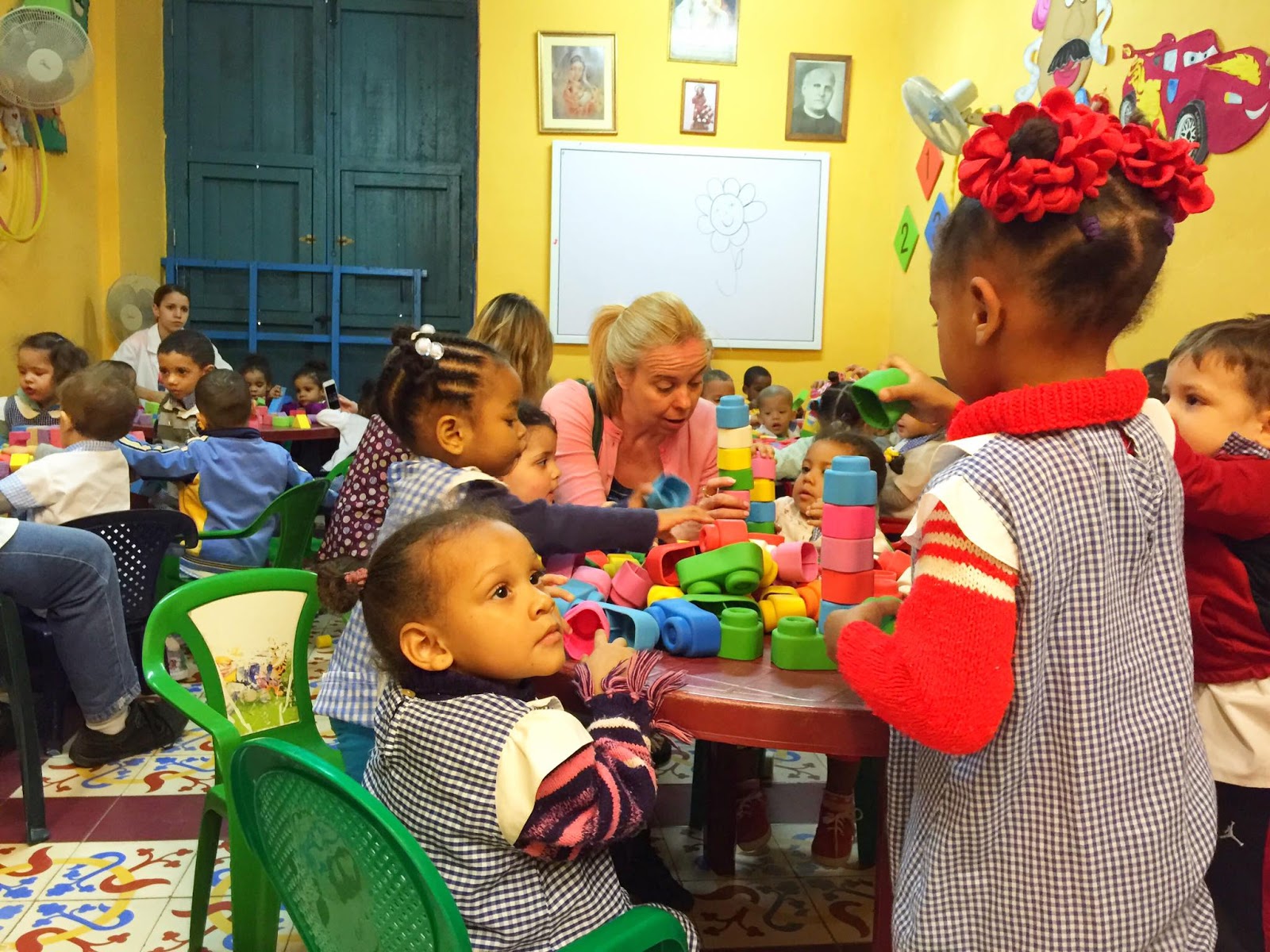
But some of our most meaningful experiences in Cuba were not planned activities. We brought with us a suitcase full of small items to donate, because we knew that people in Cuba are in need of everything: soap, shampoo, toothpaste, medicines, toys, pretty much anything you can think of. During our group’s walking tour of Old Havana, we passed a building where Adrian casually stopped to take photos of some floor tiles that caught his attention. An old man beckoned him inside, and they began to talk. The building turned out to be a preschool for disadvantaged children of single mothers, run by nuns, and supported entirely by donation.


The children at the preschool.


On our last day in Cuba, before going to the airport, about 10 members of our tour group returned to the preschool and donated everything we’d brought with us. The nuns gave us a tour of the school and let us play with the children and take photos. The nuns provide everything for about 160 kids in different age groups from 2 to 5 years: education, clothing, food, even assistance to some of their families. Their mothers drop them off in the morning before work and the nuns stay with them until the last mother returns to pick up her child.

Children dancing and singing at the preschool.


We kept it together while we were with the kids, but outside in the street after we left, we all cried. A special bond was forged that day between the school and several members of our tour group; we found a way to give something back to Cuba in appreciation for all that it had given us during our short stay. A group of us will be keeping in touch with the nuns at the school and organizing some efforts to provide further assistance to the children there. Stay tuned for ways you can participate if you feel inspired.

We are back in the U.S. now, and re-adjusting to the familiar American comforts that we took so much for granted before our trip to Cuba: Internet access, mobile phones, credit cards, clean water from the tap, a car with seat belts and a muffler, stores overflowing with tens of thousands of food and clothing options to choose from. But a piece of our hearts is still back in Cuba—celebrating and aching at the same time—and we will have no choice but to go back soon to find it again.

Outside the door of the preschool.

Wednesday, August 22, 2012

A Monk No More

It has been quite some time since readers of this blog last heard from me. Many people have written or approached me to say how much they would like for me to continue writing here. I can only say that it has always been my intention to return to this blog, and add (feebly, in my defense) that life since I last wrote anything here has been, well, a bit of a rollercoaster.

About a month-and-a-half ago marked my one-year anniversary of being back in New York City, following a two-year odyssey of living as a temporary monk at a Buddhist monastery in the remote wilds of Eastern Canada. It was while living that frequently charmed life — nestled between ocean and mountains and supported by the insular rhythms of monastic rituals and hours of daily contemplative practice — that I wrote most of the essays that appeared on this blog to date. And it was through that particular filter of experience that most of you saw me and got to know me here.

That life now seems like such a distant memory to me that it’s sometimes hard to believe I was actually living in the monastery, wearing maroon robes, a year-and-a-half ago. So much water has passed under the bridge of life since then, and so much has changed. As Heraclitus said, "You could not step twice into the same river; for other waters are ever flowing on to you."

People in New York City often have a wide-eyed expression when I tell them about my time in the monastery, and (assuming they aren't looking at me with suspicion or pity) they seem to regard it as proof of some special ability on my part. “Wow, that’s amazing” is usually followed quickly by “I could never do that” or “I can’t sit still” or “I would go crazy” or “I can’t imagine being without my iPhone.” Little do they know that I can’t sit still either, and sometimes I went crazy in the monastery, and even though I lived an hour’s drive from the nearest cellular signal, I still had my iPhone at my side and used it as a WiFi device to check my email and Facebook accounts. You can take the monk out of New York, but you can’t take New York out of the monk.

With most New Yorkers, the next series of questions usually goes something like this: “So, when you were living in the monastery, were you celibate? Really? Wait, so you mean you didn’t have sex with anyone? No one? For two whole years? Not even once? You’re kidding! Oh my God! I would die. So, wait, I hope it doesn’t make you uncomfortable that I’m asking you all these questions? Are you sure? Okay, so, I mean, did you at least...you know? Oh my God, I would die!” Well, here I am. I did not die, and neither would you. Personally, I think a two-year sabbatical from sex and romance did me a lot of good.

Actually, I like to think it did me a lot of good but I don’t really have any proof of that. My post-monk intimate life in New York has certainly not been anything that I would hold up as a role model for anyone. About a month after I landed back in the city I met someone and fell deeply, madly in love — in the intense, all-or-nothing way that perhaps only someone who has been starved for intimate connection for several years can fall in love. But love, as it often does, stayed for a little while and then abruptly went away, and I was left holding a bag with the broken pieces of my heart in it. Only I now had another person’s name written on each of those pieces and I couldn’t seem to wipe it off. When I came back from the monastery, my heart was wide open and strong, wider and stronger than it has ever been. But by the time love was done with me, my heart was shriveled and bruised and enfolded upon itself, and I felt weaker than I have ever felt in my life.

It has taken me some time to be able to look back on that experience and say that it was probably exactly what I needed, and that it arrived and departed exactly when it was supposed to. But I can say that now, and there are even occasional moments when I can say it and actually mean it.

Once people have gotten past the sex questions, they usually want to know what was it that led me to go to the monastery, and what did I learn while I was there? What did I get out of it? Did I find enlightenment? Have amazing spiritual realizations? Achieve inner peace? “You seem, like, so Zen, so chill. That must be from your time in the monastery.” No, actually, I was always pretty much like this. It’s just my outward persona. And you can ask my close friends about how Zen and chill I really am. They know you can scratch off the polished Zen facade and you'll find someone underneath with all the neuroses of Woody Allen and all the maudlin narratives of Adele, just waiting to come out.

I used to say, when asked, that what I brought home from the monastery was a sense of being more comfortable in my own skin, and a stronger feeling of compassion for others. But I don’t even make those small claims anymore. Since my return I’ve been tested enough times — by love, by family, by friends, by the noise and greed and rush of New York City itself — to know that my compassion often flies out the window when it’s needed most, and I can still find myself at times wanting to be in a thousand other skins than my own. La piel que habito no es siempre lo que quiero habitar.

As for why I went to the monastery in the first place, well, it had something to do with wanting to explore my spiritual development — which is to say, my growth as a human, as a being, as a human being — in an intense, all-or-nothing way that no other environment or path seemed to offer. (You see, I suppose I fell into monkhood as blindly and whole-heartedly as I fell in love.)

The other day I came across a quote by one of my favorite Buddhist teachers, Ken McLeod, who seemed to sum it all up:

“As long as you limit your experience to what fits into the world of society, you will explore your spiritual potential only to the extent that it doesn’t impinge on your life in society.”

Going to the monastery was a way of trying to explore my spiritual potential to the fullest extent I could at the time, no holds barred. Frankly, nothing — except, perhaps, joining the circus — could “impinge on your life in society” more than moving to an isolated spiritual community and donning the robes and following the vows of a monk — the epitome of someone who walks away from society and all its materialistic expectations. Going to the monastery was going against the stream of everything society said I should be doing instead. And it was an immersion into the formalities of spiritual practice that I realize I may never be able to duplicate in my life outside the monastery. I also recognize that it was an experiment that not everyone has the luxury of making, and that I was fortunate to have had the experience, however challenging it may have been at times. And in the end, I’m keenly aware of the fact that I came out of it with nothing in particular to show for it. Only a deeper sense of connection to the world and to myself, and a deeper willingness to work on myself and nourish my strengths and know my weaknesses — to accept myself, warts and all.

And for now that is enough.


Saturday, April 23, 2011

Love's in Need of Love Today

This morning I attended a funeral service for an acquaintance who died last week. Most of the small, Acadian town here turned out for the service -- a very traditional Catholic funeral in the town's single, large cathedral.

Having grown up Baptist, I always feel like I've stepped into another world when I visit a Catholic church, with its alien liturgies and rituals and rich iconography. The feeling of being a visitor from another planet was heightened, this morning, by my being dressed conspicuously in the robes of a Buddhist monk, which literally marked me as an alien presence and made it impossible to pretend otherwise. But the local people here are accustomed to having Buddhist monks in their midst.

Since this morning, I've been reflecting on something the priest said during his homily. "In order to experience life in its fullness, we must share the fullness of God's love with others." To put that into more secular language: no man is an island. We are relational creatures, and we find and experience the fullness of meaning in our lives through the love, kindness and compassion that we give and receive in relationship to one another.

The Buddha expressed this as the truth of interdependence. We do not actually exist as solid entities, separate from one another; we "inter-are," as Thich Nhat Hanh puts it. In the fullness of realizing our interdependence, we feel others' pain as our own, and there are no barriers to the natural flow of love and kindness. Sounds like heaven, doesn't it?

Meanwhile, back on earth, there seems to be no shortage of barriers blocking the flow of kindness and compassion between human beings. Open the newspaper or turn on the TV. The world is hurting, burning with violence and conflict. "Hate's goin' round, breaking many hearts," mourns Stevie Wonder. "The force of evil plans to make you its possession. And it will, if we let it, destroy everybody. We all must take precautionary measures."

In his book Awakening Through Love, the Dzogchen teacher Lama John Makransky writes:

"Everything that is most important to human beings is dependent upon love. Powerful and enduring love, grounded in wisdom, is the panacea to cure the ills of this world, starting with our own. We all have this curative power of goodness within us; all we need are the means to unveil it."

Replace "God" with the "power of goodness within us," and that's pretty much exactly what the Catholic priest said this morning.

Oh, and here's that Stevie Wonder song, from 1976. Its message couldn't be more true, or more timely.


Friday, April 8, 2011

Practicing Dharma Without Becoming a Doormat

Recently someone wrote to me with the following question:

How does one who is on the path practice love, tolerance, compassion, forgiveness, etc. without becoming a doormat? Our culture is so plagued with fear greed, ignorance and anger that I find it difficult to rise above it all and work from a higher spiritual plane. When people violate me, I want to fight back instead of sort of "stepping off the playing field."

Over the years, I've found that this is a frequently asked question -- especially among people who are new to the path of meditation and Dharma practice. That is not to say that it's a naive question. It's a fundamental one, for it goes right to the heart of the matter. And there is no easy answer for it. The path of Dharma does not provide us with easy, prefabricated answers to living questions; we must find our answers in each moment, and then find them again in the next.

But I've observed that this is one of those questions that ceases to plague people as they continue going deeper into their practice and spiritual path. It's not that it ever really goes away; but we begin to understand that the question hinges on a perceived separation between life and spiritual practice that doesn't truly exist.

Practicing love, tolerance, compassion, forgiveness and so on does not, of course, mean that we should make ourselves into a doormat for other people's abuse. For starters, we should extend the same friendliness and compassion to ourselves that we aspire to extend to others. The Buddha said that we could search the entire universe and we would not find anyone more worthy of our love than we ourselves are. So putting ourselves in a position of being repeatedly violated by another is not practicing compassion or love towards ourselves.

The Buddhist path is often misunderstood (and mis-applied) as a practice of passivity -- dis-engaging from the world and retreating into oneself. Certainly, retreat (in the literal sense) has its purpose and value for a practitioner, in terms of deepening and stabilizing one's own experience of truth. But real Dharma practice is not navel-gazing, or fiddling while Rome burns -- it's being fully engaged in one's life and world and relationships, with no separation and no prefabricated rules.

In the Sadhana of Mahamudra, Chogyam Trungpa described -- in poetic language -- the wisdom of a fully realized being:

He is dark red in color, symbolizing the oneness of everything within compassion. He is inseparable from peacefulness and yet he acts whenever action is required. He subdues what needs to be subdued, he destroys what needs to be destroyed and he cares for whatever needs his care.

If being inseparable from peacefulness and yet acting whenever action is required seems paradoxical, that's good -- because it is. As Zen master Suzuki Roshi said, if something isn't paradoxical, it isn't true.

As we grow on our path, we begin to see that we can act whenever action is required, but that action can come from a different motivation. It's no longer "fighting back" in the usual sense, which comes from aggression and fear, a sense of closing down and tightening. Rather, our action can come from a place of compassion and staying open to other people's basic goodness (even when they're behaving atrociously).

Sometimes that means retreating from the situation and giving it space. Sometimes it means sitting down and having a frank conversation, and sharing your perspective. Sometimes it means protesting. Sometimes it means walking away entirely, and never looking back. Sometimes it means giving someone a gift to show that you care. Sometimes it means calling the police and pressing charges. You get the idea.

There is no one-size-fits-all solution, no predetermined course of action. We meet each situation that arises with fresh awareness and open heart, and we respond in whatever way is most beneficial. Making ourselves into a doormat is rarely the appropriate response.

Tuesday, September 7, 2010

Love or Wisdom?

(Cross-posted today at The Interdependence Project.)


If you had to choose, would you rather be loved or respected?

So goes an old parlor game question. It's something of a trick question, for hidden within it there is another question: Are you the type of person who thinks the best feature of human beings is the head, or the heart? In other words, do you think intellect is the most important thing, or emotion? Wisdom or love?

In "The World's Religions," Huston Smith -- in his chapter on Buddhism -- wrote that this question, along with a couple of others, has divided people into two camps since time immemorial. He even implied that division over this question is one of the reasons why Buddhism, early in its development, split roughly into two major schools. Theravada, according to Smith, largely emphasized wisdom and insight into selflessness (anatta) as the means to personal liberation, while Mahayana emphasized love and compassion as the means to collective liberation.

Those are gross over-simplifications of both schools' views and practices. Theravada practitioners spend lots of time developing love and compassion, and Mahayana practitioners spend lots of time developing wisdom and insight into emptiness and the nature of mind. But Huston Smith argued that in terms of how the two schools differentiated themselves and what they considered to be the most important aspect to emphasize on the spiritual path, that is roughly how the chips fell.

The validity of Huston Smith's theory about Buddhism's split into two major schools is doubtful, but contemplating it does raise another interesting point. Within both schools today you can see plenty of examples of both types of people: those who consider love to be the most important thing, and those who consider wisdom to be the most important thing. Not surprisingly, perhaps, this distinction can often be seen to fall along gender lines. A quick glance around the Buddhist scene these days reveals a lot of female teachers who heavily emphasize loving-kindness and compassion and other emotional qualities of the awakened heart, and a lot of male teachers who heavily emphasize non-dual wisdom and realization of emptiness and other cognitive qualities of the awakened mind.

That is, of course, another stereotype -- for which you can find plenty of exceptions. Some female Buddhist teachers talk quite a lot about wisdom and emptiness, and some male Buddhist teachers talk quite a lot about love and compassion. Maybe a few Buddhist teachers, of either gender, even talk about both in equal measure. But stereotypes exist for a reason, and the exceptions don't necessarily disprove the rule of thumb.

Here is an experiment that would be interesting to conduct, to test whether the gender-difference theory holds water: Pick a certain number of high-profile Western Buddhist teachers from each gender -- let's say, for example, Pema Chodron, Tara Brach, and Sharon Salzberg, versus Stephen Batchelor, Robert Thurman, and B. Alan Wallace. Listen to a range of their Dharma talks and evaluate their books, scoring each one on a 10-point left/right "flavor" scale (all the way to the left being a predominantly "heart" flavor and all the way to the right being a predominantly "intellect" flavor). The scoring would naturally be subjective, but if you got enough people to participate, and factored out gender bias in the scorers by having a balance of men and women participating, I would expect that the data would reliably demonstrate a flavor difference along gender lines. (Maybe this would only prove that we perceive the teachings according to gender expectations, but that would also be an interesting finding, and worth contemplating.)

I wonder to what degree this is a Western phenomenon. In English and most Western languages, we make a very clear linguistic separation between "heart" and "mind" (and by "mind" we usually mean "head"). The Sanskrit word "citta," on the other hand, covers both aspects: "bodhicitta" is translated into English as either "awakened heart" or "awakened mind." (And which of those translations you adopt already says something about your inclinations.) That a single word could represent both of those human dimensions may seem odd to us, for we are accustomed to thinking of heart and mind as being quite distinct.

But the cultural differences don't stop there. Tibetans, when indicating the "mind," touch the chest, but touch the forehead to indicate "body." English speakers, by contrast, touch the chest to indicate "heart" (or sometimes "body") but touch the forehead (or the cranial cavity in general) to indicate "mind." Thus, the fact that English speakers see "mind" as being so distinct from "heart" arises partly from the fact that we think of "heart" (the emotional dimension of human experience) as being down in the chest but "mind" (the intellectual, cognitive dimension of human experience) as being up in the brain.

Maybe that helps to explain why we see a lot of Buddhist teachers in the West specializing primarily in one dimension or the other. Depending on which side of human nature they identify with most strongly -- the heart or the head -- they naturally emphasize those aspects of the Buddhist teachings that resonate with that dimension. That this split so often falls along gender lines, with a lot of seemingly "emotional" female teachers and a lot of seemingly "intellectual" male teachers, seems like a stereotype, but it often operates according to expectation.

There is evidence to suggest that these tendencies are hard-wired into our biology. A significant body of research has examined the differences between "male brains" and "female brains." Most men tend to have a very male brain and most women tend to have a very female brain, but everyone falls somewhere along a spectrum of brain gender. A few men tend to have a more female brain, and a few women tend to have a more male brain -- but those are the exceptions to the norm. "Aside from external anatomical and primary and secondary sexual differences," says Renato Sabbatini, "scientists know also that there are many other subtle differences in the way the brains from men and women process language, information, emotion, cognition, etc."

The male brain, it turns out, is very good at doing certain things that the female brain isn't -- and vice versa. People with very male brains excel at tasks involving a high degree of spatial awareness, motor activity, hand-eye coordination, and so on, while people with very female brains perform, by comparison, rather poorly on those tasks: thus, for instance, you almost never see any female crane operators or airline pilots. People with very female brains, on the other hand, excel at tasks involving a high degree of empathy, communication and language skills. The female brain processes information using more parts of the brain, while male brain activity tends to be more concentrated.

Thus, neuroscience suggests there are biological reasons why men tend to be more analytical and single-minded and women tend to be more emotional and communicative and oriented towards multi-tasking. It should therefore come as no surprise if a lot of male Buddhists are attracted to teachings that have a sharp, analytical flavor, and a lot of female Buddhists are drawn to teachings that have an open, emotional flavor. (I recently heard one prominent, male Buddhist teacher say that all those teachings about love and compassion are nice, and they're good to practice so that we can all get along better, but they have nothing to do with enlightenment. This struck me as a very male way of looking at it.)

As Buddhists, though, we aren't usually satisfied with just accepting what is dictated by biology and social convention. The Buddhist vision of enlightenment is often depicted as the union of masculine and feminine principles, the inseparability of wisdom and compassion or love. (Side note: oddly enough, in Tantric Buddhist iconography, the compassion aspect is represented by the male figure, while the wisdom aspect is represented by the female figure -- the reverse of what we might expect to see.) At the end of the day, we are left with the sense that this habitual separation between "head" and "heart," "intellect" and "emotion," "wisdom" and "love," is a false dichotomy. It seems to operate on the relative level, but ultimately it has no true existence. Wisdom is the space of love and compassion, and compassion and love are the expression of wisdom.

Enlightenment, in other words, involves recognizing and fully embracing within ourselves both aspects of our being: heart and mind, compassion and wisdom, masculine and feminine. We may have been born within a body -- a prepackaged biological and cultural and karmic situation -- that leads us to emphasize one over the other, but we intuitively know that our truest nature lies beyond the limitations of body and biology and culture and karma. At the level of our deepest nature, we sense that we are not only capable of fully manifesting both dimensions of experience -- we must manifest both, because we are both.

Too much emphasis on cognitive wisdom, realizing emptiness, and non-duality, without love and compassion, makes the mind too hard; our approach to enlightenment becomes overly intellectual, dry and cracked. And too much emphasis on love and compassion, without the wisdom of emptiness, makes the mind too soft; our approach to enlightenment becomes overly emotional, moldy and sticky. Just as in the classic children's story about Goldilocks, we need a path to enlightenment that is not too hard, not too soft, but just right.

But here we've run up against that old "middle way" thing once again. You just can't get away from it in Buddhism. Any time you stray to one extreme or the other, you will be called back to the middle.

Saturday, May 8, 2010

Sympathy for the Devil

Unbiased Compassion

The love and compassion of a buddha, they say, is like the sun: it shines impartially and unceasingly on all beings. There is no picking and choosing involved, no personal preferences, no hope or fear. A buddha doesn't shine the light of his compassion only on those beings he likes or who please him, and withhold it vengefully from those who fail to meet his standards. "The great Way is not difficult," said the Third Zen Patriarch, "for those who have no preferences."

Most people have no trouble extending love and compassion to the people they like, and to the people whose behavior pleases them. It's easy to love someone who's lovable. But what about someone whose behavior is unethical, or whose personality is offensive? How is it possible to extend love and compassion to someone who is, by any reasonable standard, acting like an idiot, or a poseur, or just a plain, old jerk?

I find this incredibly challenging. I can give lip service to compassion and loving-kindness, but when I'm faced with someone who's a thief and a liar, or someone who's delusional and in denial, or someone who's aggressive and abusive, it's not so easy to find the love and compassion within myself. Instead, everything in me wants to shut down and say "No!" to the offending person.

One thing that helps is to look within myself and remember that there have been times in my life when I, too, have acted selfishly -- when I was almost certainly perceived by others as a jerk (difficult as that may be for me to imagine). There have been times, too, when I was a poseur, trying to impress other people and gain social advantage. And there have been times when I acted like an idiot, when I was in denial, when I shot myself in the foot through my own stupidity.

With pretty much any quality I might find offensive in others, I can discover at least a trace of that same odious quality within myself if I look closely, and honestly. And I have first-hand experience of the fear and insecurity that drive people to behave in such ways. From there, it's not such a great leap to feel empathy for someone who has gotten so stuck in those familiar traps that they just live that way all the time.


Lies, and the Lying Liars Who Tell Them

It seems that America, my home country, has grown into a nation divided against itself. The never-ending power struggle between progressives and convervatives, left and right, has reached a crescendo of bitterness and animosity that I've never seen before, and that has perhaps not been seen since the Civil War. Citizens of the same country are pitted against each other, determined to fight for their values and defining themselves in opposition to the enemy. It seems more difficult than ever for people on either side of the divide to be compassionate and respectful and tolerant towards those on the other side.

Politically speaking, I know which side of the divide I stand on, and it's not with the likes of Rush Limbaugh or Sarah Palin. But when I look at such people, and at the whole conservative backlash that's now taking place against Obama's rise to power, I can infer the fear and pain that they must be in to make them behave as they do. After all, I suffered the same kind of fear and pain and anguish throughout all eight years of the most recent Republican administration.

It is sad that the vitriolic, "Drill, baby, drill!" nonsense being passed off as public discourse by so many Republicans and Tea Partiers could actually garner so much national attention, and stir up so much animosity and ill-will in people on both sides of the political spectrum. And it is nauseating when individuals who are visibly bloated with prejudice and aggression and greed, masquerading cynically in the name of family values and patriotism -- "Lies and the Lying Liars Who Tell Them," to borrow a phrase from Al Franken -- are placed in positions of power and influence.

The past week has brought us several outrageous examples (as if more proof were needed) of the widespread hypocrisy of conservatives. Now that BP's catastrophic oil spill in the Gulf of Mexico is threatening the U.S. coastline from Texas to Florida, suddenly we don't hear them chanting "Drill, baby, drill!" anymore. And yet another prominent Republican and anti-gay activist, the Baptist minister George Alan Rekers, has been caught and exposed with his hand in a male prostitute's cookie jar. How many of these right-wing homophobes have now been outed as closeted homosexuals? I hope someone is keeping a list of these guys -- I've lost count. Rekers cynically claims that he hired the RentBoy.com hooker, and took him on a European vacation, only in order to share the gospel of Jesus with him and save him from his sinner's lifestyle -- but the prostitute affirms to the Miami New Times that they shared a lot more than that.


Sympathy for the Devil

Even as I oppose, on general principle, the entire conservative movement and most of the things for which it claims to stand, it is still possible (admittedly, with great effort) to feel compassion and kindness towards the human beings who comprise that movement. To borrow a phrase from their own playbook: "Love the sinner, hate the sin." The internalized homophobia and loneliness of people like George Alan Rekers is profoundly sad, and having experienced the pain of those feelings myself, I know that as a human being he is worthy of compassion, not mockery. The pain that drove Rush Limbaugh to become a pill-popping drug addict is also not completely foreign to me. To allow my moral outrage at such people's hypocritical actions and deeply misguided political views to make me hate them would be playing right into their hands. It would be stooping to their level. In spite of my outrage, somewhere inside I know exactly where these people are coming from. Their pain is my pain. But it's so easy to forget that.

This doesn't mean that we should agree with anything that Sarah Palin, for example, has said or might conceivably say, or that -- Heaven forbid -- we should ever allow her to be voted into a national office. But the similarities between us are greater than the differences. Not only are we citizens of the same struggling country, facing the same set of problems, but we are both human beings -- citizens of the same struggling planet. We both feel pain and fear; we both want to have happiness and want to avoid suffering. In the larger scheme of things, the distinctions between us are negligible, almost non-existent. Deep inside, beneath our differences, I am Sarah Palin -- and so are you.

Last week, President Obama addressed the University of Michigan's graduating class and urged them to maintain "civility" in political discourse -- even as a shrill cabal of Republicans and Tea Partiers protested outside and accused him of being a "socialist." Obama's call for civility -- for simple human courtesy and reasonable, respectful dialogue in politics -- sounds almost quaint, a throwback to an earlier, more innocent time in American life when civility was a value that meant something to most people. Listen for five minutes to one of today's conservative shock-jock radio shows and you'll know that civility doesn't mean a damn thing anymore.

But the virtue of civility is precisely what is most needed today; it is the only thing that will de-escalate the bitter, bipartisan stalemate and hateful, internecine struggle that have become the hallmarks of American politics. Civility would be a step towards real patriotism. We can all agree to disagree, and we can work towards solutions to our problems. But it would be a lot less painful for everyone if, in the process, we were to maintain some degree of respect and compassion towards one another. The unbiased compassion of a buddha shines impartially on all beings, even on hypocrites and liars and hate-mongers and shock-jocks and spin-doctors and greedy, thieving rogues.

Tuesday, March 31, 2009

I Love You

As I begin to write this I am in a plane en route to Halifax, a brief stopover on my way to Gampo Abbey, a Buddhist monastery at the far end of Nova Scotia, where I plan to live for a year or more. Following a call from inside me that has made itself heard these past months, I am taking a leap into the unknown, into full-time spiritual practice and discipline, into a new environment and a new way of life. For the moment, for the year, for I don't know how long, I have left behind two decades of history in New York City and said goodbye to job, apartment, friends, and most of my worldly possessions. Quite literally, as the old John Denver song goes: "I'm leaving on a jet plane, don't know when I'll be back again."

Although I cannot know what kinds of teachings lie ahead of me on this leg of the journey, I do know now, beyond a doubt, that the process of getting ready to embark on it has been profound and transformational.

For the past several days, a beautiful old Marvin Gaye song, "God Is Love," has been running the loop inside my head. Those who know me personally may find it hilarious to know that I'm identifying so strongly at this pivotal moment in my life, as I'm entering a Buddhist monastery, with a Christian gospel song, but to me the song's theological perspective is beside the point. The underlying message is universal. In it, Gaye urges the skeptical listener not to disparage his friend God, who "made this world for us to live in, and gave us everything." Then Gaye makes his main point: "All He asks of us [in return] is we give each other love."

Love your mother (she bore you)
Love your father (he works for you)
Love your sister (she's good to you)
Love your brother (your brother!)

I am taking Gaye's advice to heart. In a way, that is the reason I am embarking on this journey inwards and launching myself, physically and otherwise, into the open arms of a new family of full-time spiritual practitioners: to deconstruct some of the walls around my heart and learn, I mean really learn, what it is to love. What other journey is there?

Never in my life have I felt the love and support of my friends and family as strongly as I have felt it this week, as they have said farewell to me and wished me happiness on my path (even from those who do not understand the choice I have made). My eyes have been blasted open to see, with a new clarity, how much our paths are intertwined. I feel a deep respect and affection for every human being who has touched my life, at this transitional moment when, paradoxically, I have left so many of those very people behind me as I travel north to a country I have never seen before.

A close disciple once said to the Buddha, in a reflective moment, that good companions accounted for half of the spiritual path. The Buddha replied: "Do not say it is so. Good companions are the *whole* of the spiritual path."

For the first time, I feel that I can appreciate what the Buddha meant by that.

To every person who has shown me kindness and supported me on my life's path, my gratitude overwhelms me at this moment and I have no words to express it. Tears well up and I'm trying, right now, not to cry into my keyboard for fear of short-circuiting my laptop.

It is in this way that we must train ourselves: by liberation of the self through love. We will develop love, we will practice it, we will make it both a way and a basis, take our stand upon it, store it up, and thoroughly set it going.

- Shakyamuni Buddha